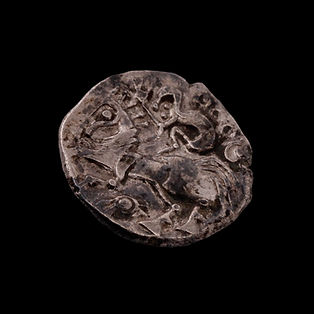
IRON AGE COINS,
EAST WEAR BAY, FOLKESTONE
These gold and silver coins form part of a much larger collection of coins that were found over the course of several seasons of excavation work on a cliff-top site overlooking East Wear Bay in Folkestone. The coins date from the late second century BC through to just before the Roman Conquest in AD 43.
The coin collection includes examples minted locally in Kent, but also imports from other regions of southern Britain and from across Gaul (modern France and Belgium), suggesting extensive trading connections.
Date: Late Iron Age, late second century BCE to mid first century AD
OBJECT
Origin and discovery
During the late Iron Age period, from about 150 BC, population and settlement numbers were growing and it was a time of great change in southern Britain. This period witnessed the introduction of several new technologies in Britain including the use of the wheel for pottery production, the first use of coinage and the importation of luxury goods including wine and possibly exotic foodstuffs from the expanding Roman world. Coinage first began to be used in Britain under the influence of the Roman Empire. A large assemblage of Iron Age coins comes from a settlement site at East Cliff, overlooking East Wear Bay. Whilst a good number of coins have been recovered during archaeological excavations here, many have also been found on the beach below the site, eroded out of the cliff. Most of the coins have been produced locally, within Kent, but some examples are from much further afield including coins minted in Gaul (modern France and Belgium). This suggests occupants from the Folkestone settlement had extensive trading connections. Other examples were produced from within Britain including coins from Dorset and areas well to the north of the Thames. Elsewhere in the surrounds of Folkestone, a hoard of late Iron Age coins was discovered by a metal-detectorist on the southern slopes of Round Hill in 1979. The hoard comprised at least 67 coins that belong to the Kentish Primary potin Series. Folkestone town had long been known as an important settlement since the Anglo-Saxon period, but it was not until the early twentieth century that archaeological discoveries at East Cliff, to the north-east of the main historic settlement, revealed traces of Folkestone’s earlier, Roman and pre-Roman past. Roman remains had first been discovered eroding from the cliff-top at East Cliff, above East Wear Bay in about 1919. Extensive excavations led by Sussex archaeologist S.E. Winbolt followed in 1923–4. These succeeded in exposing the foundations of a large Roman villa complex, with impressive sea views across the Channel to the French coast. Throughout the period prior to the Second World War (1939–45) these archaeological remains were a major attraction for tourists visiting the town. Winbolt’s investigations, although not of the highest calibre by today’s archaeological standards, established the basic sequence of events on the site and exposed a complete ground plan for the main buildings of the Roman villa. He was also able to identify the presence of pre-Roman activity on the site, although the extent, complexity and significance of this was not fully understood then. Gradually, the exposed Roman walls started to deteriorate and damage and neglect during the Second World War, combined with declining visitor numbers in the post-War years, led to the covering of the villa site with soil in 1957. The gradual erosion of the coastal cliffs which first brought the site to light in the early twentieth century has not stopped. Excavations carried out by the Kent Archaeological Rescue Unit in 1989 established that up 10 metres of masonry at the south-eastern end of the Roman villa complex had been lost since Winbolt’s day. When the villa was first excavated in 1924 there was around 30 metres of land between the North-East Wing of the main villa house and the cliff edge. By 2010 this figure had been reduced to 2.25m. The site is therefore in an increasingly precarious position! The coins have been recovered during several seasons of DAG (Dover Archaeological Group) and CAT-led community excavations at the site since 2010. These excavations have revealed initial habitation at the site occurred during the early Iron Age and that sometime during the late Iron Age, perhaps beginning around 100 BC, this occupation became more intense across the site.
Use
The coins found at the settlement site would have most likely been used for trading purposes. However, late Iron Age coins have also been found in some contexts as votive offerings. Those found at Round Hill in 1979 came from an uncertain context; one suggestion being that the hoard was deliberately buried as a votive offering as it was found near a fresh water supply in the form of springs at Holy Well. During the Iron Age, natural springs, rivers and other watery places were treated with reverence and possibly the location of a god, deity or sprit. The act of depositing coins within water is still widely practiced today with coins thrown into ‘wishing wells’ and into famous fountains such as the Trevi fountain in Rome and the Trafalgar Square fountain in London. The density of late Iron Age coinage from the settlement at Folkestone indicates the presence of a major late Iron Age site that preceded construction of the first Roman villa complex in the late 1st century AD. No obvious ritual contexts are noted within the settlement site and the coins appear to represent lost coinage.
ARCHIVE
Current Location
Canterbury Archaeological Trust archives.
Catalogue Entry
Site code: ATU.
SF27 (66); Silver, late Iron Age, Picardy thin-silver type (North Gaulish), 100-90 BC. Diameter: 15mm Weight: 0.67g. Shows an abstract horse.
SF158 (69) Gold, late Iron Age, Morini. AV 1/4 stater. Galls-Belgie, 58-54 BC. Diameter: 12mm Weight: 1.36g. Shows a geometric tree design. Others of its type sometimes have a boat on the back.
SF578 (573) Silver, late Iron Age, Cantiaci. Uninscribed Series, 40-25 BC. Diameter: 13mm, Weight: 1g.
SF702 (668); Silver, late Iron Age, Cantiaci. AR unit. Uninscribed Series, 40-25 BC. Diameter: 14mm, Weight: 1g. Shows a slightly less abstract horse.